
- Home
- Listing Platforms
- Case Studies
- Media Kit
- Insights
-
Get partner insights from The Beat Asia. Sign up for audience trends, campaign opportunities, and platform updates across our six cities, straight to your inbox.
Click here to subscribe.Press & Marketing
Listing Platforms
The Beat Digital Group Limited. All rights reserved.

The Busy-season demand map
Strategy · july 24, 2026
How Hong Kong's busy season is really decided — from the quiet weeks of August to the December peak.
There’s a version of the busy season that most Hong Kong operators plan for, and a version that actually happens. The one they plan for is a calendar of dates — the December rush, the year-end functions, the festive season. The one that happens is quieter and earlier: a long research phase, weeks before any of those dates, in which diners, planners and companies quietly decide where they’ll go. By the time a booking lands, the choice behind it was usually made some time ago.
That gap — between when the decision is made and when the money moves — is the most useful thing an operator can understand about the months from August to year-end. It’s where visibility either works for you or quietly costs you. What follows is a map of that period: where Hong Kong’s demand builds, in what order, and what it asks of a venue that wants to be on the shortlist rather than chasing it.
The backdrop. Hong Kong’s second half runs hot. The city drew 49.9 million visitors in 2025, up 12% year on year (HK Tourism Board). It hosted Asia’s 50 Best Restaurants for the first time in March 2026, and the 2026 MICHELIN Guide again awarded nine three-star restaurants across Hong Kong and Macau. The demand is real — the question this piece answers is when it’s decided.
The shape of the season
Hong Kong’s busy season isn’t one long build to December. It moves in four distinct phases, each with its own audience and its own lead time. Plan against the phase you’re actually in, rather than the date on the calendar, and the whole period gets easier to work.
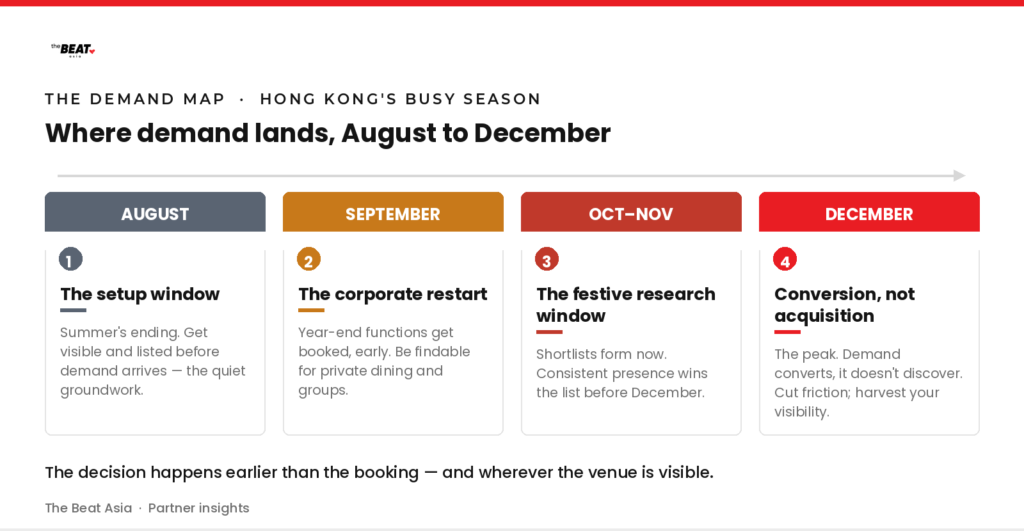

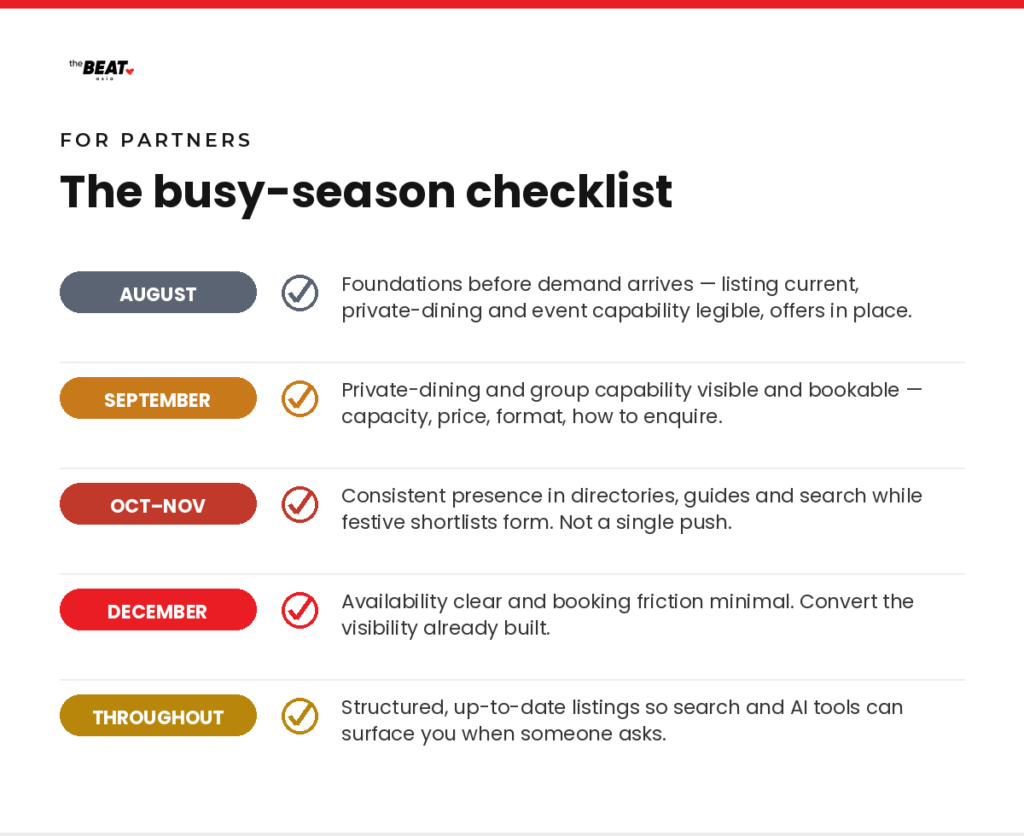
The busy season doesn’t announce itself. It starts quietly, in the weeks when it looks like nothing is happening. Through August, Hong Kong is still in summer mode — travel, heat, thinner calendars — and it’s easy to treat the month as downtime. For an operator, that’s exactly what makes it valuable. August is the setup window: the last stretch before demand arrives, and the cheapest, least crowded moment to become visible before everyone else does.
The work here isn’t campaigns. It’s foundations — making sure your listing is current, your private-dining and event capability is legible, and your seasonal offers are in place before the searching starts. The venues that look effortless in December are usually the ones that did this unglamorous groundwork in August, while the market was still at the beach.

The clearest signal that the busy season has begun isn’t festive at all. It’s corporate. As teams return to a full schedule, year-end planning starts: client dinners, team functions, the entertaining that companies budget for and book well ahead. These aren’t spontaneous walk-ins. Someone is tasked with finding a venue, and they start by looking — searching, shortlisting, asking the same question a dozen venues could answer but only a few will actually surface for.
For an operator, September is where private-dining and group capability needs to be visible and legible — not just that you have a room, but what it seats, what it costs, and how to book it. The venues that capture year-end corporate trade are rarely the cheapest. They’re the ones that were easy to find and easy to say yes to when the planning began.

This is the part of the season most worth understanding, because it’s where the December outcome is largely decided. Through October and November, diners and planners move into festive mode — but researching, not yet booking. They’re building shortlists for team lunches, festive dinners, and the private events that cluster around year-end. They read the roundups. They search for the festive set menu, the private room for twelve, the Christmas lunch in their district. They save options.
What matters here is a hard truth about attention: the shortlist forms before the booking, and it forms around whoever is visible at the moment of research. If your venue only becomes active in December — a late campaign, a burst of posts — you’re arriving after the list is written. The venues on it have been consistently present through the weeks when people were still deciding: in the directory, in the editorial guides, and in the answers that search and AI tools return.
Consistency is the whole game in this window. Not a single big push, but a steady presence that’s already there when someone starts looking.

By December, the market isn’t really discovering anymore. It’s confirming. The searches that happen now are narrower and closer to intent: checking availability, comparing two saved options, booking. That changes what December is for. It’s less a month to win new attention and more a month to convert the visibility you built in October and November.
The operators who feel December as a scramble are usually the ones who skipped the research window and are now trying to buy attention at the most crowded, most expensive point in the year. The ones who feel it as a harvest did the visible, unglamorous work earlier. December is the peak — and it rewards preparation more than effort.
What this means for how you plan
Read the four phases together and one principle runs through all of them: in Hong Kong’s busy season, the decision consistently happens earlier than the booking, and it happens wherever the venue is visible. Which leads to a short, unfashionable conclusion — the work that matters most isn’t the December campaign. It’s being present, consistently and legibly, through the weeks before each phase peaks.
By December, the market isn’t really discovering anymore. It’s confirming. The searches that happen now are narrower and closer to intent: checking availability, comparing two saved options, booking. That changes what December is for. It’s less a month to win new attention and more a month to convert the visibility you built in October and November.
The operators who feel December as a scramble are usually the ones who skipped the research window and are now trying to buy attention at the most crowded, most expensive point in the year. The ones who feel it as a harvest did the visible, unglamorous work earlier. December is the peak — and it rewards preparation more than effort.
Where being visible early actually happens
This is where a content-led platform earns its place. The Beat Asia’s role through this period is to be where the research happens — the editorial guides diners read, the directories planners search, and the structured listings that search and AI tools draw from when someone asks where to go. Being present there through late summer and autumn is what puts a venue on the shortlist before December narrows it.
Three ways operators use it across this window. A Spaces listing gives event spaces and venues a strong, year-round presence for private hire, events and group bookings — the corporate and festive trade that starts searching in September. A Dining Passport listing keeps F&B concepts and their seasonal offers continuously visible across the directory and editorial roundups through the research months. And a City Guide presence puts a venue in the guides and searches diners actually read while they’re still deciding.
The common thread is timing. Each of these works because it’s in place before the demand arrives — not because it shouts louder once everyone else does. If the busy season is on your plan, the moment to be visible is now, while the shortlists are still being written.
See where your venue fits across the season
Request the Q4 media kit for the full picture — placements, the seasonal editorial calendar, and the dates each one closes. Or list your venue directly through the Partner Portal.

The Very Heart of Asia's Lifestyle.


Listing Platforms
Press & Marketing
2021–2026 © The Beat Digital Group Limited. All Rights Reserved.